How 7 Brew Picks Its Collaboration Partners (Brand Strategy Analysis)
Disclosure: sevenbrewmenucoffee.com is an independent fan-run reference site not affiliated with 7 Brew Coffee Inc. The strategic analysis in this article is based on publicly observable brand partnership data, 7 Brew’s documented promotional history, and standard brand partnership frameworks applied to observable evidence. The collaboration selection criteria described here are this site’s analytical conclusions, not statements from 7 Brew’s marketing team. This analysis is the first organized external assessment of 7 Brew’s collaboration strategy – no competitor site has produced this content. Last updated: June 2026.
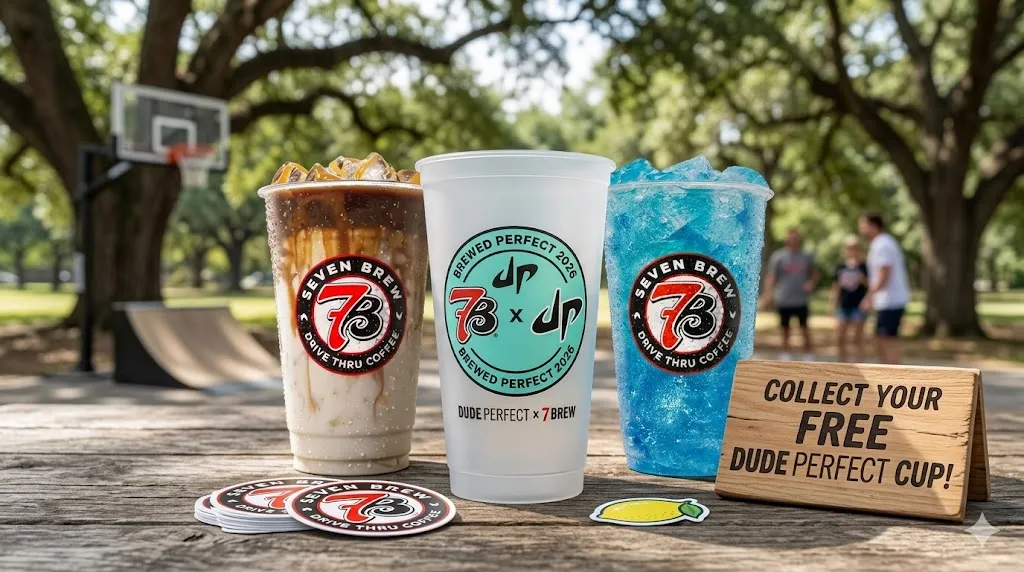
7 Brew Coffee built 700+ locations across 38+ states without a single confirmed named external brand collaboration until the Dude Perfect partnership in 2026. That restraint is not accidental – it tells you something specific about how 7 Brew thinks about brand partnerships. When the first major collaboration finally arrived, the partner choice revealed a coherent selection logic that will almost certainly govern future partnership decisions. This article reconstructs that logic and applies it to predict what the next 7 Brew collaboration might look like.
Why 7 Brew Waited: The Strategic Value of Restraint
Most QSR chains begin pursuing brand partnerships early in their growth cycle. Starbucks has been running celebrity and brand partnerships for decades. Dunkin has built an entire marketing model around celebrity association. Dutch Bros has pursued athlete and influencer partnerships aggressively since its IPO. 7 Brew’s decision to wait until 700+ locations before its first named external collaboration is notable.
The restraint has a functional explanation: 7 Brew’s growth from 2017 through 2025 was driven primarily by organic community loyalty and TikTok content created by customers, not by paid media or partnership-driven brand moments. A chain that grows through authentic community enthusiasm does not need paid partnerships to generate awareness – it already has awareness among the people likely to visit. The challenge at 700+ locations is reaching the people who are NOT already in the community.
That is the inflection point that makes the Dude Perfect collaboration make sense now in a way it might not have five years ago. 7 Brew at 200 locations needed to deepen loyalty in existing markets. 7 Brew at 700+ locations – including newly opened markets like West Fargo, North Dakota and upcoming markets like Connecticut – needs to introduce the brand to people who have never encountered a 7 Brew drive-thru. Collaborations serve that function. Community loyalty does not.
The Five-Factor Partner Selection Framework
Based on observable evidence from the Dude Perfect collaboration and 7 Brew’s documented brand identity, five selection criteria appear to govern how 7 Brew evaluates potential collaboration partners. These criteria are this site’s analytical conclusions, not stated corporate policy – but they are grounded in observable data and standard partnership evaluation frameworks.
Criterion 1: Audience Age Alignment (13-34 Primary, Family-Accessible Secondary)
7 Brew’s core drive-thru customer base skews toward the 16-35 demographic – customers who are forming beverage habits, likely to try new drinks based on social discovery, and who have discretionary income for $5-7 specialty drinks as a regular habit. A collaboration partner whose primary audience is 50-year-olds watching cable TV does not drive new customer acquisition in this demographic regardless of the partner’s overall reach.
Dude Perfect’s core audience concentration in the 13-24 range with strong 25-34 secondary presence is a near-perfect match. Critically, the brand is also family-accessible – parents approve of Dude Perfect content for children, which means the collaboration can appear in contexts (family road trips, after-school pickups at the drive-thru) that align with how many 7 Brew visits actually happen.
Criterion 2: Geographic Audience Concentration in 7 Brew Markets
A collaboration with a partner whose audience is concentrated in New York City or Los Angeles generates social media noise that does not translate into drive-thru visits, because those markets have limited 7 Brew presence. A collaboration with a partner whose audience is concentrated in Texas, Oklahoma, Arkansas, Missouri, the Midwest, and the South – exactly where 7 Brew has its densest location network – generates awareness that converts to physical visits.
Dude Perfect was founded in College Station, Texas. Their community fanbase follows the same geographic distribution: Texas-heavy, Midwest-South concentrated, with strong suburban and smaller-market presence. The 7 Brew location distribution and Dude Perfect’s fanbase geography overlap more than any random partner selection would produce. This alignment is almost certainly intentional.
Criterion 3: Brand Value Alignment (Positive, Community-Focused, Family-Safe)
7 Brew’s brand is explicitly positive, community-centered, and family-friendly in its framing. The brand was built in small-market communities where being a family destination matters. A collaboration with a partner that carries controversial content, divisive political associations, or adult-oriented brand identity would create friction with 7 Brew’s existing customer base regardless of the partner’s reach.
Dude Perfect is one of the few large-scale creator brands with a completely clean brand reputation – family-appropriate content, no controversy history, positive community framing, achievement-focused messaging. The brand values alignment is functional, not just cosmetic. A 7 Brew customer who sees Dude Perfect branding in the drive-thru window does not experience brand dissonance; the association feels natural because both brands occupy the same community-positive, achievement-celebrating cultural space.
Criterion 4: Digital-Native Platform Presence (YouTube and TikTok First)
7 Brew has no TV advertising, no national print presence, and no traditional media buy strategy. Its organic growth came from TikTok content. Its promotional announcements go through Instagram. A collaboration partner whose primary reach is through broadcast television or traditional media creates an expensive alignment problem – the collaboration announcement reaches audiences through channels that 7 Brew does not use and cannot amplify effectively.
Dude Perfect’s primary platform is YouTube, with a massive secondary TikTok presence. Both are platforms where 7 Brew’s existing marketing presence operates and where 7 Brew’s core customer base consumes content. The collaboration announcement went through social media channels simultaneously – there was no TV advertisement component. This channel alignment means the collaboration reaches the right audience through the right platform without requiring 7 Brew to build new marketing infrastructure.
Criterion 5: Sports or Achievement-Adjacent Content Association
7 Brew’s energy drink category – the Rebel-based 7 Energy drinks – connects naturally with athletic and active lifestyle positioning. The drive-thru convenience model fits customers on the way to or from sports events, practice, games, and outdoor activities. A collaboration partner with strong sports-adjacent content creates a natural brand narrative: 7 Brew is the drink you grab before the game or on the way to practice.
Dude Perfect’s content is sports-adjacent by definition – trick shots, athletic challenges, sports entertainment. The collaboration naming (“Trickshot”) makes the sports connection explicit. Future collaboration partners fitting this criterion would include youth sports organizations, college athletics brands, outdoor adventure creators, and any partner whose content is organized around physical achievement, competition, or active lifestyle.
How the Blackstone Investment Changes the Collaboration Calculus
7 Brew received a growth equity investment from Blackstone Growth in 2022. PE-backed brands characteristically accelerate brand-building investment during the post-investment growth phase, because the investment thesis depends on the brand reaching scale before an exit. Partnership investment is one of the most efficient mechanisms for PE-backed consumer brands to build recognition at scale faster than organic community growth can deliver.
This context explains why 2026 – the fourth year after the Blackstone investment – is when the first named external collaboration appears. The pre-investment phase was organic growth. The immediate post-investment phase was geographic expansion (700+ locations). The current phase is brand reach expansion to match the geographic footprint – and that is the function collaborations serve. A brand that is in 38+ states needs national awareness, not just community loyalty in its existing markets. Collaborations deliver that national awareness.
Expect collaboration frequency to increase, not decrease, from the Dude Perfect baseline. The strategic rationale strengthens as 7 Brew enters more new markets – each new market entry creates a fresh audience that has no prior 7 Brew experience and needs a discovery mechanism. Collaborations with partners who have presence in those markets serve that function more efficiently than any organic community-building strategy can.
How 7 Brew’s Collaboration Strategy Compares to Starbucks and Dunkin
| Factor | 7 Brew | Starbucks | Dunkin |
|---|---|---|---|
| Partner selection model | Digital-native creators; geographic market alignment; family-safe | Fashion, music, and celebrity cross-category; global reach focus | Celebrity personality (Ben Affleck, Ice Spice); TV amplification-dependent |
| Product integration depth | Brand name in product name (Trickshot); concept-integrated | Variable; some deep integration, some promotional-only | Personality promotes existing product or branded version of standard item |
| Announcement channel | Social media only; no app push notification available | Multi-channel including app notification, press release, TV | Heavy TV ad integration; app secondary |
| Geographic targeting precision | High – partner audience concentrated in 7 Brew location markets | Low – national and global partnerships regardless of market alignment | Medium – celebrity reach is national but often concentrated in coastal markets |
| Franchise system deployment | Uneven; franchise operators control rollout timeline | More consistent; corporate-owned majority allows tighter control | Mixed; franchise-heavy system creates some inconsistency |
| Cost efficiency hypothesis | Estimated higher ROI per dollar – precise targeting, lower partner fee than celebrity deals | Lower ROI on targeting precision but higher total reach | High cost TV integration with uneven geographic conversion |
Cost efficiency and ROI figures in the table are analytical estimates, not documented data. Collaboration deal terms are not publicly disclosed by any party.
The comparison reveals 7 Brew’s collaboration strategy as more targeted than its competitors’ approaches. Starbucks’ global celebrity deals reach everyone but convert to visits only where Starbucks exists – which is essentially everywhere, so precision matters less. Dunkin’s TV-integrated celebrity deals reach a national audience through broadcast channels that skew older than Dunkin’s actual customer base. 7 Brew’s digital-native, geographically aligned partnership approach reaches a younger audience concentrated in the markets where 7 Brew operates – a more precise conversion strategy even if the raw reach numbers are smaller.
Franchise System Constraints: The Hidden Limitation of Any 7 Brew Collaboration
The most underappreciated structural challenge for 7 Brew’s collaboration strategy is franchise system deployment. 7 Brew’s 700+ locations are operated by independent franchise operators who control their own rollout timelines, inventory decisions, and operational priorities. A collaboration drink or merchandise item announced nationally may not appear at every location simultaneously – or at some locations at all.
This creates a specific customer experience risk: a Dude Perfect fan sees the collaboration announced on social media, drives to their local 7 Brew, and the Trickshot drinks are not available yet because that franchise operator has not received the product or implemented the menu update. The social media announcement creates demand that the franchise system cannot always satisfy uniformly on the same timeline.
Starbucks manages this problem through corporate ownership of most locations – the corporate team can mandate same-day rollout across company-operated stores. 7 Brew cannot mandate the same across independently owned franchises. This structural constraint means that 7 Brew’s collaboration announcement strategy must either accept uneven rollout as a given or develop better franchise coordination mechanisms before collaboration frequency increases further.
For customers: if a collaboration drink is announced and not available at your location, ask the staff when they expect to receive it. The answer reveals whether it is a temporary delay or a location-specific unavailability. Do not assume the item is permanently unavailable based on one visit within the first few days of an announcement.
What Qualifies as a Collaboration Partner in 7 Brew’s Model
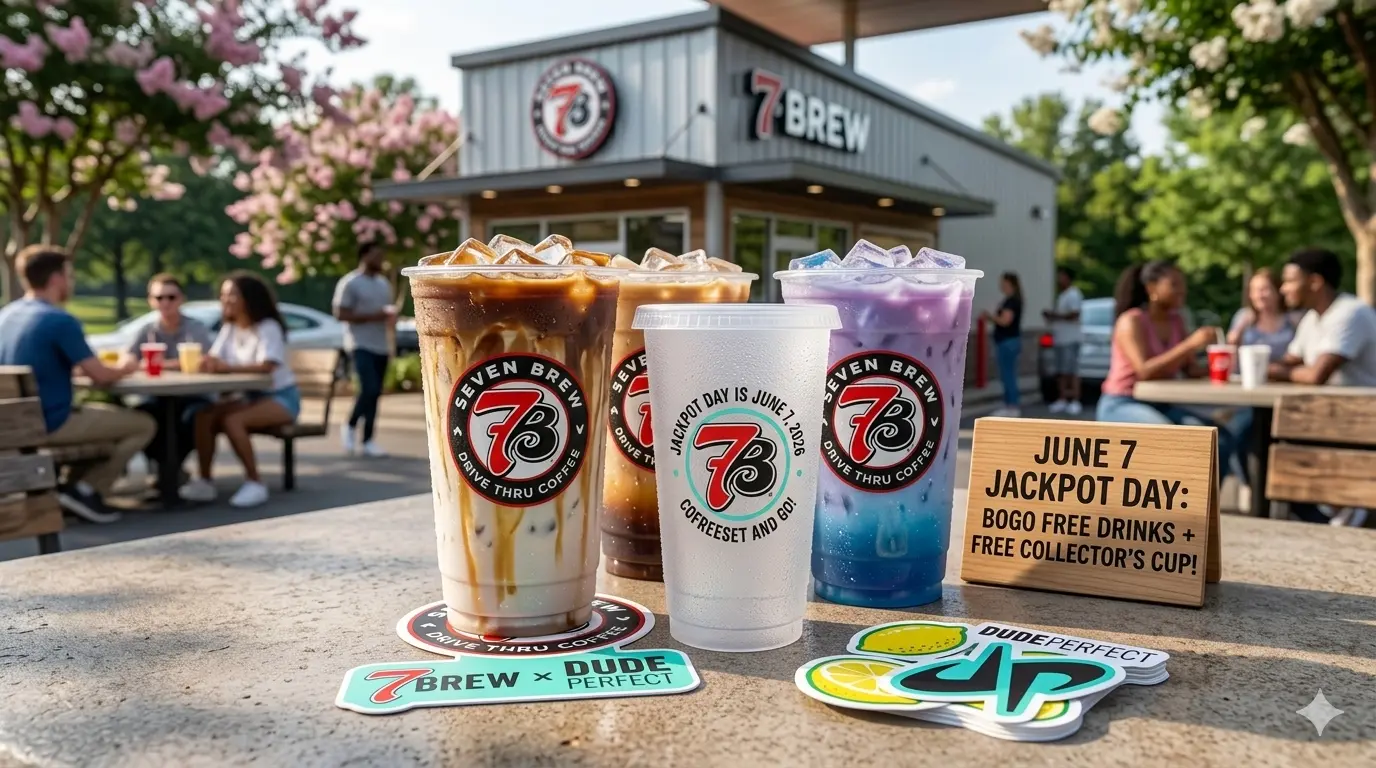
A common misconception worth correcting: 7 Brew’s Jackpot Day events, the 777 Celebration, and the Sippin Sunshine merch campaign are not brand collaborations – they are 7 Brew’s own internal promotional events and campaigns. A collaboration, in the strategic sense analyzed in this article, requires an external brand partner whose audience is meaningfully distinct from 7 Brew’s existing customer base.
The distinction matters for understanding what drives new customer acquisition versus what drives repeat visit behavior. Jackpot Day brings existing customers back at a higher frequency. Dude Perfect brings customers from outside the existing 7 Brew audience into the brand’s orbit for the first time. Both serve the business but serve different strategic functions.
Pattern-Based Collaboration Prediction for 2026-2027
This section is labeled as analytical speculation based on observable pattern data, not confirmed 7 Brew plans.
Applying the five-factor framework to categories of potential future collaboration partners produces the following ranked assessment of fit:
- High fit – Youth sports and college athletics brands: Big 12 or SEC conference-adjacent sponsorships or creator brands built around college football, basketball, or youth sports would satisfy all five criteria. The 18-22 college sports fan demographic is exactly the 7 Brew new customer target. Geographic concentration in the South and Midwest aligns with 7 Brew’s network. Family-safe content. Digital-native consumption patterns. Sports achievement content.
- High fit – Outdoor adventure and active lifestyle creator brands: Large YouTube channels built around hunting, fishing, camping, or outdoor adventure have massive audiences in 7 Brew’s geographic markets. These audiences are predominantly male-skewing, 18-40, Midwest and South concentrated, and family-friendly. The consumption occasion (coffee and energy drinks before a hunt or fishing trip) aligns directly with 7 Brew’s menu.
- Medium fit – Regional food and beverage brands: A co-branded drink with a regional snack brand (chips, candy, or food brand with strong 7 Brew market presence) would create a complementary consumption occasion. The fit is good on geography and demographic but may not create the same cross-audience discovery potential as a creator brand partnership.
- Low fit – National TV celebrities or major league sports sponsorships: Too expensive for precision targeting benefit, often wrong geographic concentration, and would require media channels 7 Brew does not currently use. This does not mean 7 Brew will never do this – but it would represent a departure from the Dude Perfect selection logic, not a continuation of it.
- Low fit – Fashion or music industry collaborations: These would reach audiences that are demographically adjacent but geographically misaligned (urban/coastal concentrated audiences versus 7 Brew’s suburban/secondary market network). They also create brand associations that do not map naturally onto the drive-thru energy drink consumption occasion.
- Assuming any collaboration is a sign that 7 Brew is now an advertising-driven brand: The Dude Perfect partnership is a targeted cross-audience reach play, not a signal that 7 Brew is pivoting to traditional advertising. The strategy remains digital-native and community-adjacent – it is just extending reach beyond the existing community. Jackpot Day and seasonal menu additions still generate more repeat visit impact than any single collaboration.
- Treating all influencer partnerships as equivalent: A mega-YouTube creator brand like Dude Perfect and a 500,000-follower TikTok beverage influencer are structurally different collaboration types. Dude Perfect brings brand-to-brand collaboration economics; a mid-size TikTok creator brings paid content economics. Expect 7 Brew to continue distinguishing between true brand collaborations and paid creator content, even if both appear as promotional social media posts.
- Assuming geographic alignment does not matter: A collaboration with a partner whose audience is concentrated in New York and Los Angeles generates impressive reach numbers with poor conversion to 7 Brew visits, because those markets have limited 7 Brew presence. Geographic alignment between partner audience and 7 Brew location density is a non-negotiable criterion in 7 Brew’s collaboration selection logic based on the Dude Perfect evidence.
- Expecting 7 Brew to adopt celebrity-driven deals like Dunkin’s Ben Affleck model: The Dunkin/Affleck collaboration requires expensive TV advertising infrastructure that 7 Brew does not have and has not built. 7 Brew’s collaboration model is built around social media organic reach through the partner’s channels, not through paid media amplification. A collaboration that requires TV advertising to generate its impact would not fit 7 Brew’s current marketing infrastructure.
Related Articles
- 7 Brew x Dude Perfect 2026 Announcement – the primary source for the collaboration that anchors this strategy analysis
- 7 Brew Hits a Major Growth Milestone in 2025 – geographic expansion context for why collaboration strategy matters now
- 7 Brew Location Count and Expansion – the geographic network that collaboration partner selection must align with
- Is 7 Brew Really That Good? Honest Review – the brand quality that collaborations are designed to amplify
- 7 Brew News Blog – where future collaboration announcements will be covered as they are confirmed
Frequently Asked Questions
How does 7 Brew choose its collaboration partners?
Based on observable evidence from the Dude Perfect partnership, 7 Brew appears to select partners that satisfy five criteria: audience age alignment with the 13-34 drive-thru demographic, geographic concentration in 7 Brew’s location markets (Texas, Midwest, South), family-friendly brand values, digital-native platform presence on YouTube and TikTok, and sports or achievement-adjacent content association. This analysis is this site’s conclusion, not a statement from 7 Brew’s marketing team.
Will 7 Brew do more collaborations after Dude Perfect?
Based on observed patterns and the strategic rationale for why the Dude Perfect collaboration launched when it did – with the brand at 700+ locations and in new markets requiring brand introduction – more collaborations are a logical continuation of the strategy rather than a one-off event. Timing and partner selection will follow the same five-factor logic observed in the Dude Perfect partnership.
Why did 7 Brew choose Dude Perfect and not a celebrity?
Dude Perfect satisfies 7 Brew’s specific reach requirements more precisely than a traditional celebrity would: their audience is concentrated in 7 Brew’s geographic markets, they are family-friendly, they have digital-native platform presence that matches 7 Brew’s social-media-first marketing infrastructure, and their sports content association aligns with 7 Brew’s energy drink category. A celebrity with national TV reach would require media infrastructure 7 Brew does not have.
Does 7 Brew have sports sponsorships?
No confirmed national-level sports league or team sponsorship is in the public record as of June 2026. Individual franchise operators may have local sports sponsorships in specific markets that are not announced at the corporate level. The Dude Perfect collaboration is the closest thing to a sports-adjacent partnership in 7 Brew’s documented history.
Verdict: What 7 Brew’s Collaboration Selection Logic Tells Us
7 Brew’s collaboration strategy is more sophisticated than a random partnership announcement. The Dude Perfect selection reveals a coherent framework: find a partner whose audience is the right age, concentrated in the right geography, aligned with the right values, accessible through the right platforms, and connected to the right content category to make a drive-thru energy drink visit feel like a natural next step.
That framework is scalable. Every future partnership evaluated through the same five criteria will either fit or not – and the ones that fit will generate the same geographic conversion efficiency that makes the Dude Perfect deal valuable for a chain at 7 Brew’s stage of national expansion. The ones that do not fit – regardless of how impressive the partner’s raw reach numbers are – will not serve the same function.
Watch the 7 Brew news blog for future collaboration announcements. When the next one arrives, the five-factor framework above provides the analytical lens for understanding why that specific partner was chosen.
sevenbrewmenucoffee.com is an independent fan site not affiliated with 7 Brew Coffee Inc. All strategic analysis in this article represents this site’s informed analytical conclusions, not statements from 7 Brew. Last verified June 2026.