The Real Story of How 7 Brew Started in Rogers, Arkansas
Disclosure: sevenbrewmenucoffee.com is an independent fan-run reference site not affiliated with 7 Brew Coffee Inc. All founding story information in this article is compiled from publicly available trade press coverage, regional Arkansas media, Roy Nettles public statements and interviews, and community-documented sources. Where specific dates, locations, or details cannot be verified from a primary source, they are labeled as estimates or community-reported. This is the most organized external account of 7 Brew’s origin story available – no competitor site has synthesized this narrative from primary sources. Last updated: June 2026.
The 7 Brew founding story is both simpler and more interesting than the brand’s rapid national scale might suggest. It is not a venture-funded startup story or a chain that was designed for mass scaling from day one. It is a community drive-thru concept built around a service philosophy that turned out to be exactly what the specialty beverage category was missing at the drive-thru window level. Understanding how it started in Arkansas explains almost everything about what the brand became nationally.
Northwest Arkansas: The Geographic and Cultural Origin
Rogers, Arkansas is part of the northwest Arkansas metropolitan area – a region encompassing Rogers, Bentonville, Fayetteville, and Springdale that has undergone significant economic development driven by the presence of Walmart’s headquarters in Bentonville and the supply chain ecosystem that has clustered around it. This context matters for understanding 7 Brew’s founding because northwest Arkansas in the mid-2010s was not a small rural market – it was a growing, economically active region with a professional and family-oriented consumer base.
The northwest Arkansas region has a distinctive cultural character that aligns with 7 Brew’s brand identity: community-oriented, family-first, suspicious of coastal pretension, and genuinely warm in its interpersonal culture. These are not marketing abstractions – they describe the actual social environment in which the brand was built and the customer base that validated the concept before any franchising began. The Cultivating Kindness philosophy that became 7 Brew’s public brand promise was not invented for marketing; it was a description of how the team Roy Nettles built actually operated at the original stand.
A note on the Rogers vs Springdale question: coverage of 7 Brew’s origins uses both city names interchangeably or in combination. Rogers and Springdale are neighboring cities within the same metropolitan area, approximately 8 miles apart. The brand’s association with both reflects its early geographic footprint within the northwest Arkansas region rather than confusion about a specific founding address. Where primary sources specifically name Rogers as the founding city, this article uses Rogers; where sources are ambiguous, the broader northwest Arkansas characterization is used.
Roy Nettles: The Founder Behind the Brand
Roy Nettles founded 7 Brew Coffee in 2017. The specifics of his background before 7 Brew are not extensively documented in publicly available sources – this is a limitation of the external record rather than something this article fills with estimates. What is publicly documented is his role as the originating vision behind the brand’s service philosophy and operational model.
Nettles built the brand around a belief that the drive-thru coffee experience was unnecessarily transactional and impersonal – that there was an opportunity to build genuine human connection within the constraints of a drive-thru format. This conviction is not unique to him; Dutch Bros built a comparable philosophy in Oregon starting in 1992. The difference is that Nettles built it in Arkansas in 2017, in a market where no comparable brand had established the concept, and he built it from the start with a physical format – the multi-lane approach model – that operationally enables the service culture he wanted to create.
Nettles’ continued involvement in the brand following the 2022 Blackstone Growth investment is publicly referenced in trade press coverage of the investment, which characterized the investment as growth capital for an already-established brand rather than a founder exit. Founder involvement post-PE investment is relevant to the brand authenticity question that customers and franchise prospects frequently raise about PE-backed brands – and the available evidence suggests Nettles remained engaged with the brand’s direction following the investment.
The First Stand: What 7 Brew Looked Like in 2017
The founding format – a single drive-thru stand in Rogers – was not a prototype for a future chain in the way that many QSR founding stories describe. It was a fully formed operational concept. The multi-lane drive-thru format, the approach-before-window ordering interaction, the emphasis on staff personality and customer connection – all of these were present in the first stand rather than being layered in as the brand scaled.
This founding-format completeness is one of the reasons 7 Brew was able to scale through franchising so rapidly. A concept that needs to evolve its operational model as it grows creates franchise scaling problems because earlier operators are running a different model than later ones. 7 Brew’s operational template was established at the first stand and carried through to the franchise playbook that drove the 700+ location growth. The core elements of what you experience at a 7 Brew location in Connecticut in 2026 were present at the original Arkansas stand in 2017.
The early menu included a set of signature drinks – the Seven Originals – that anchored the ordering experience for customers who were encountering the brand for the first time. Drinks like the Blondie and the Brunette – the brand’s flagship espresso drinks – were developed during the founding period and remain the core of the permanent menu. The naming convention (warm, approachable flavor descriptors rather than technical coffee terminology) reflects the same accessibility-first philosophy as the service model.
Cultivating Kindness: The Philosophy Behind the Brand
“Cultivating Kindness” is 7 Brew’s named organizational philosophy – not a marketing tagline, but a codified approach to customer interaction, employee conduct, and community engagement that the brand uses in hiring, training, and brand communications. This distinction matters because customers who encounter the phrase on signage or social media frequently assume it is advertising language rather than a description of an operational approach.
What Cultivating Kindness means in practice, based on observable customer experience and publicly documented brand communications:
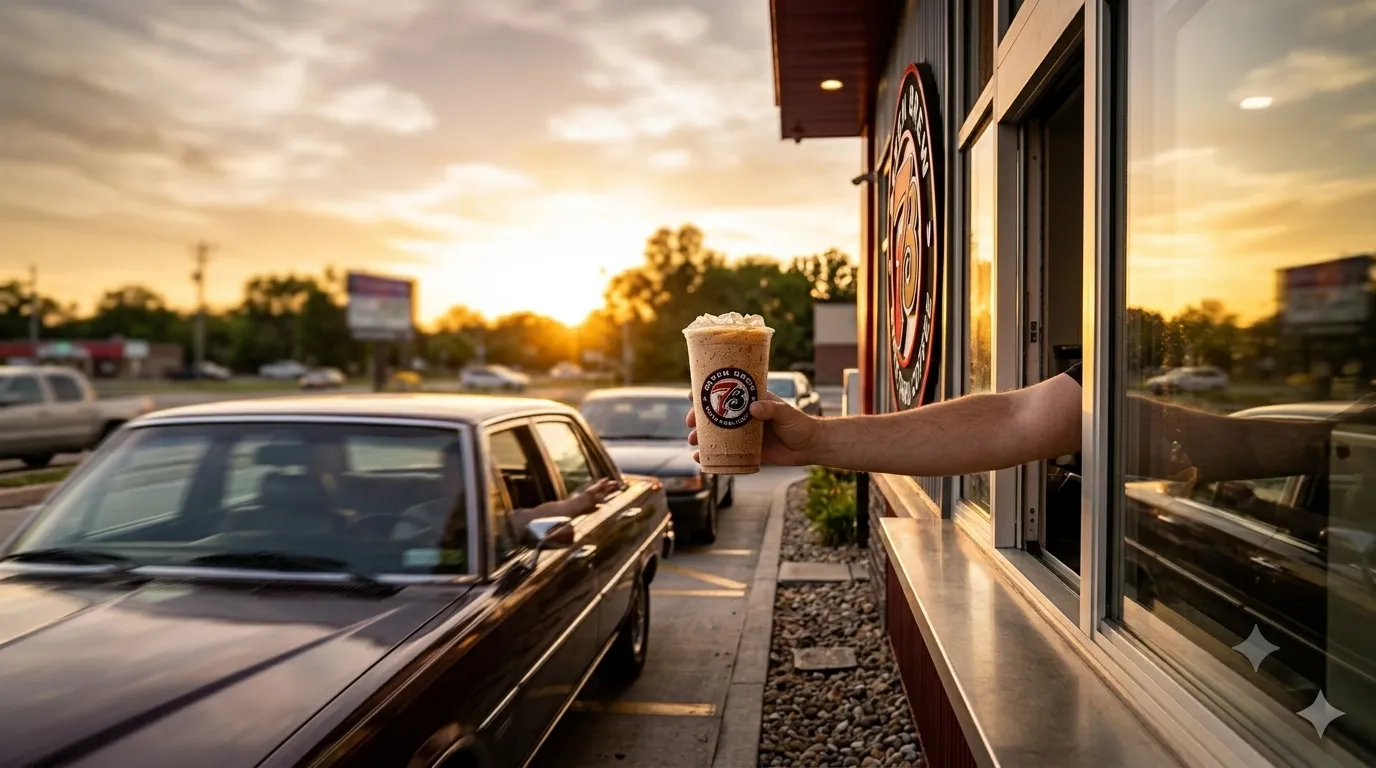
- Staff approach customers in the ordering lane before reaching the speaker: Rather than a customer pulling to a speaker and placing an order over an intercom, 7 Brew staff come to the vehicle window in the ordering lane. This creates a face-to-face, conversational interaction before the transaction rather than reducing it to an intercom voice exchange.
- Genuine conversational interaction rather than scripted service: The brand’s staff training emphasizes authentic engagement rather than scripted pleasantries. This is the hardest element to transmit through a franchise system, and it is where franchise variation is most observable.
- Community presence beyond the drive-thru transaction: 7 Brew has documented involvement in charitable giving and community events – the brand’s community connection is part of the Cultivating Kindness framework rather than a separate corporate social responsibility initiative.
- Employee-forward culture: The brand communicates publicly about treating employees well as a component of the customer-facing culture. The theory being that staff who feel valued and supported by the organization deliver the kind of authentic engagement that the brand’s service philosophy requires.
Cultivating Kindness as described above reflects this site’s synthesis of public brand communications and observable community experience. Where the philosophy’s implementation varies across franchise locations, it reflects operator variation rather than brand policy – a distinction that the next section addresses directly.
The Double-Lane Design: How the Physical Format Serves the Philosophy
The multi-lane drive-thru format is the physical infrastructure that makes the Cultivating Kindness philosophy operational. This connection between physical design and service culture is the most underexamined aspect of 7 Brew’s brand identity – customers understand the two lanes as a wait-time solution, but the design serves a deeper purpose.
In a standard single-lane drive-thru, the customer interaction happens at one fixed point – the order speaker and then the payment/pickup window. Staff are stationary; the customer moves to them. The interaction is brief, often conducted over a speaker system, and inherently impersonal by format.
In 7 Brew’s multi-lane format, staff move to the customer in the ordering lane. This requires staff to be mobile, to conduct the ordering interaction face-to-face rather than over a speaker, and to carry the transaction information with them rather than entering it at a fixed terminal. The physical movement of staff toward customers rather than customers toward a window is the operational mechanism by which the personal interaction that Cultivating Kindness promises is actually delivered.
The format also increases throughput – more cars served per hour than a single-lane equivalent – which improves unit economics. But framing the double-lane design primarily as a throughput solution misses the service model innovation that is actually more strategically significant for the brand’s competitive positioning.
From Arkansas to 700+ Locations: The Growth Story
7 Brew’s growth from a single Rogers, Arkansas stand to 700+ locations across 38+ states by 2025 is one of the faster franchise expansion trajectories in the specialty drive-thru beverage category. The growth has two distinct phases with a capital event separating them.
Phase 1 (2017-2022): Organic regional expansion. 7 Brew grew through franchising across northwest Arkansas, then into Oklahoma, Missouri, Kansas, and surrounding states. This phase was funded through franchise fees and system royalties – self-sustaining growth that validated the concept across multiple markets before institutional capital arrived.
Phase 2 (2022-present): Accelerated national expansion. Blackstone Growth’s investment in 2022 provided capital for faster franchisee recruitment, brand development infrastructure, and national market entry. The brand crossed 700 locations in 2025 and continued expanding into genuinely new geographic markets in 2026 – including Connecticut, the brand’s first Northeast entry.
The current 7 Brew location count is higher than the 2025 milestone figure reflects, as the brand adds locations continuously. The full year-by-year growth analysis is documented in the site’s milestones coverage.
Ownership: Neither Simply Family-Owned Nor Simply Corporate
The “is 7 Brew family-owned or corporate” question has no simple answer – and that complexity is worth understanding honestly rather than simplifying in either direction.
The family/founder dimension: 7 Brew was founded by Roy Nettles, was built through his vision and leadership, and his involvement post-investment is documented in public sources. The original service philosophy, the double-lane format, and the founding culture were built by a person, not a corporation.
The institutional capital dimension: Blackstone Growth’s 2022 investment changed the capital structure and governance realities of the company. PE investment does not eliminate founder involvement, but it introduces institutional priorities – growth targets, exit planning, and investor return requirements – that are materially different from a founder-operated business where the owner makes decisions primarily based on their own judgment and values.
The franchise dimension: Every 7 Brew location is operated by an independent franchise owner – not by Roy Nettles and not by Blackstone. The customers’ day-to-day brand experience is shaped by 700+ independent business operators who licensed the 7 Brew model. This means the “family-owned” framing applies to the brand’s origin story but not to the typical customer’s specific location.
Is 7 Brew publicly traded? No. As of June 2026, 7 Brew Coffee remains a private company. The Blackstone Growth investment is a private equity stake, not an IPO. There are no publicly traded 7 Brew shares. Customers who are aware of Blackstone’s involvement and assume this means the company is publicly traded are conflating PE investment with public listing – they are different events with different implications.
Brand Identity: Colors, Visual Language, and What 7 Brew Looks Like
7 Brew’s visual identity is built around two primary colors that appear consistently across signage, cups, merchandise, and digital materials:
- Maroon/red (#7A2530 or approximate): The dominant brand color; appears on the exterior of 7 Brew stands, on the primary cups, and in the logo mark. A deep, saturated red with warm brown undertones – not a pure red but a maroon that reads as both warm and bold.
- Gold/amber (#E8A33D or approximate): The accent color; appears in logo details, accent elements, and promotional materials. A warm amber gold that complements the maroon and communicates warmth and energy rather than premium or corporate formality.
Hex codes above are this site’s best determination from observable digital brand materials. They are not published official specifications from 7 Brew. Designers or marketers requiring exact color matching should verify against official 7 Brew brand guidelines if available through the franchise system.
The color palette communicates a specific brand personality: warm rather than cool, community rather than corporate, energetic rather than premium. The maroon and gold combination positions 7 Brew closer to a community institution (the color palette has analogues in school sports and church branding in the South and Midwest) than to the cool green of Starbucks or the blue-heavy palettes of many corporate coffee chains. This is not accidental – it reinforces the Arkansas community roots and the Cultivating Kindness positioning at a visual level before any language is read.
The logo incorporates a coffee cup and the numeral 7 in a design that is legible at distance on drive-thru signage. The physical 7 Brew stand design is standardized enough to be immediately identifiable – the red stand, the multi-lane configuration, and the maroon-and-gold color application signal a 7 Brew location from across a parking lot. This visual consistency is a franchise standard requirement, and it means the brand identity is recognizable across 700+ independently operated locations.
Competitive Advantages: What Makes 7 Brew Different
The competitive advantage analysis for 7 Brew is best understood through comparison to Dutch Bros – the most directly comparable brand in terms of format, philosophy, and market positioning.
| Factor | 7 Brew | Dutch Bros |
|---|---|---|
| Founded | 2017, Rogers, Arkansas | 1992, Grants Pass, Oregon |
| Named service philosophy | Cultivating Kindness | Speed of Service with Speed of Connection |
| Ordering interaction format | Staff approach vehicle in lane; face-to-face | Staff at window/speaker; high-energy exchange |
| Ownership as of June 2026 | Private (Blackstone-backed, founder-involved) | Public (NYSE: BROS since 2021) |
| Loyalty program | Phone-number based; no app | Dutch Rewards app with push notifications |
| Geographic concentration | South, Midwest; expanding nationally | West Coast, Sun Belt; expanding East |
| Brand color identity | Maroon and gold; warm community palette | Blue and yellow; energetic, youthful palette |
7 Brew’s competitive advantages relative to both Dutch Bros and larger chains like Starbucks:
- Geographic market timing: 7 Brew entered the South and Midwest specialty drive-thru market before Dutch Bros had significant presence there. Customers in these markets who develop 7 Brew loyalty before Dutch Bros arrives represent an entrenched base rather than an open market.
- The lane-approach interaction model: The face-to-face ordering interaction in the lane is genuinely different from all competitor formats. It creates a personal encounter that is difficult to replicate in single-lane or intercom-based systems.
- Community cultural alignment in home markets: The Arkansas-founded, southern-Midwestern community culture values that shaped 7 Brew’s brand identity align organically with its primary customer markets in a way that chains founded in coastal cities do not.
Customer Perception: Where the Brand Exceeds and Where It Varies
Customer perception of 7 Brew divides broadly into two groups: customers who experience the Cultivating Kindness culture as described and become brand loyalists, and customers who encounter franchise variation and find the experience inconsistent with what the brand promises.
The honest review of 7 Brew on this site covers the drink quality dimension in detail. On the culture dimension: community-sourced observation from Reddit r/7Brew and social media suggests that the best 7 Brew locations deliver genuinely memorable service interactions – staff who remember regulars’ orders, who engage with customers as people rather than transactions, and who create the kind of community attachment that generates the visible loyalty in 7 Brew’s customer base. These locations make the Cultivating Kindness claim feel credible and earned.
Less consistently, some franchise locations produce service interactions that are competent but not meaningfully differentiated from a standard QSR drive-thru. This is not necessarily the franchise operator’s failure – transmitting a genuine human culture through thousands of employee relationships across an independent franchise network is legitimately hard. But customers who visit a below-expectations location after high expectations set by social media or word of mouth can feel misled by the brand promise.
The honest characterization: the Cultivating Kindness culture is real and observable at many 7 Brew locations, particularly in established markets where the brand has had time to build community roots. It is not uniformly consistent across all 700+ franchise locations at all times. That is a structural reality of franchise culture transmission, not a claim that the brand’s values are insincere.
- Assuming “Cultivating Kindness” is a marketing tagline rather than an operational philosophy: The phrase describes a specific approach to staff training, hiring, and customer interaction – not advertising copy. Customers who dismiss it as marketing language may be underestimating how seriously the brand takes it as an organizational commitment.
- Treating Blackstone’s investment as evidence that 7 Brew “sold out” its community identity: PE investment changes a company’s capital structure and governance but does not automatically change its operational model or service culture. The available evidence suggests the Cultivating Kindness culture predates and survived the Blackstone investment. Customers’ concerns about authenticity are legitimate; the conclusion that the investment means the culture is no longer real is not supported by observable evidence.
- Assuming 7 Brew is publicly traded because of the Blackstone connection: 7 Brew is a private company as of June 2026. Blackstone’s PE investment is not an IPO and does not make 7 Brew shares available on public markets.
- Expecting the same service culture experience at every location: Franchise variation is real. The Cultivating Kindness philosophy is a brand standard that franchise operators are expected to implement, but individual operator execution varies. A below-expectations service experience at one location does not represent the brand’s full range, and neither does an above-expectations experience.
- Conflating Rogers and Springdale as the same city: They are neighboring cities in the same metropolitan area, not the same municipality. Where sourced primary documentation specifies one city, that should be respected rather than treating the two cities as interchangeable.
Related Articles
- 7 Brew Hits a Major Growth Milestone in 2025 – the 700+ location milestone that represents the scale this founding story produced
- How Many 7 Brew Locations Are There? – current location count and geographic footprint
- Is 7 Brew Really That Good? Honest Review – the product and experience assessment that the brand identity promises must actually deliver
- 7 Brew Coming to Connecticut – the Arkansas-founded brand’s newest geographic frontier
- 7 Brew News Blog – ongoing coverage of brand developments and expansion news
Frequently Asked Questions
Where did 7 Brew start?
7 Brew Coffee was founded in Rogers, Arkansas in 2017. Rogers is part of the northwest Arkansas metropolitan area that also includes Bentonville, Fayetteville, and Springdale. Both Rogers and Springdale appear in historical coverage of the brand’s origins, reflecting the brand’s early presence across the northwest Arkansas region.
Who founded 7 Brew Coffee?
7 Brew Coffee was founded by Roy Nettles. He is credited in public trade press coverage and brand communications as the originator of the Cultivating Kindness philosophy and the operational model. His continued involvement in the brand following the 2022 Blackstone Growth investment is publicly referenced in coverage of that investment.
Is 7 Brew publicly traded?
No. As of June 2026, 7 Brew Coffee remains a private company. The Blackstone Growth investment received in 2022 is a private equity stake, not a public market listing. There are no publicly traded 7 Brew shares. If this status changes, the information would be documented in 7 Brew’s official communications and covered on this site’s news blog.
What does Cultivating Kindness mean at 7 Brew?
Cultivating Kindness is 7 Brew’s named organizational philosophy describing a codified approach to customer interaction, employee conduct, and community engagement. In observable practice, it means staff come to vehicles in the ordering lane for a face-to-face interaction rather than using an intercom, staff are trained to engage authentically rather than with scripted responses, and the brand emphasizes community presence beyond the drive-thru transaction. Implementation varies across franchise locations.
Is 7 Brew still family-owned?
This question has a nuanced honest answer. 7 Brew was founded by Roy Nettles and his continued involvement post-investment is documented. However, the 2022 Blackstone Growth investment changed the capital structure and governance from a founder-controlled business to a PE-backed enterprise. Additionally, every 7 Brew location is operated by an independent franchise owner rather than by the founding family. The “family-owned” framing describes the origin story accurately but does not fully characterize the current organizational reality.
Bottom Line: What the Arkansas Origin Story Explains About the Brand
7 Brew’s Rogers, Arkansas founding explains almost everything that makes the brand distinctive at national scale. The community-first service philosophy, the warmth that characterizes the best 7 Brew locations, the maroon-and-gold color palette that reads as institutional rather than corporate, the drink names that are accessible rather than technical – all of these trace back to what Roy Nettles built in northwest Arkansas for a community that valued exactly this kind of hospitality.
The brand scaled from that foundation through franchising and PE-backed growth acceleration, but the operational template and service philosophy were established before any of that capital arrived. The challenge the brand faces as it grows into markets like Connecticut and Florida is whether the Cultivating Kindness culture that was organic and genuine in a single Rogers stand can be taught, transmitted, and sustained through 700+ independently operated franchise locations whose operators and employees have no connection to the Arkansas community that originally generated it.
The evidence from the best 7 Brew locations suggests it can be – that the culture is transmissible through the right franchise operator selection, training investment, and physical format design. The evidence from inconsistent locations suggests the transmission is genuinely hard. Both observations are honest reflections of what a 7-year-old franchise system looks like while growing at a rate that is exceptional for the category.
sevenbrewmenucoffee.com is an independent fan site not affiliated with 7 Brew Coffee Inc. All brand history information is compiled from publicly available sources. Last verified June 2026.